
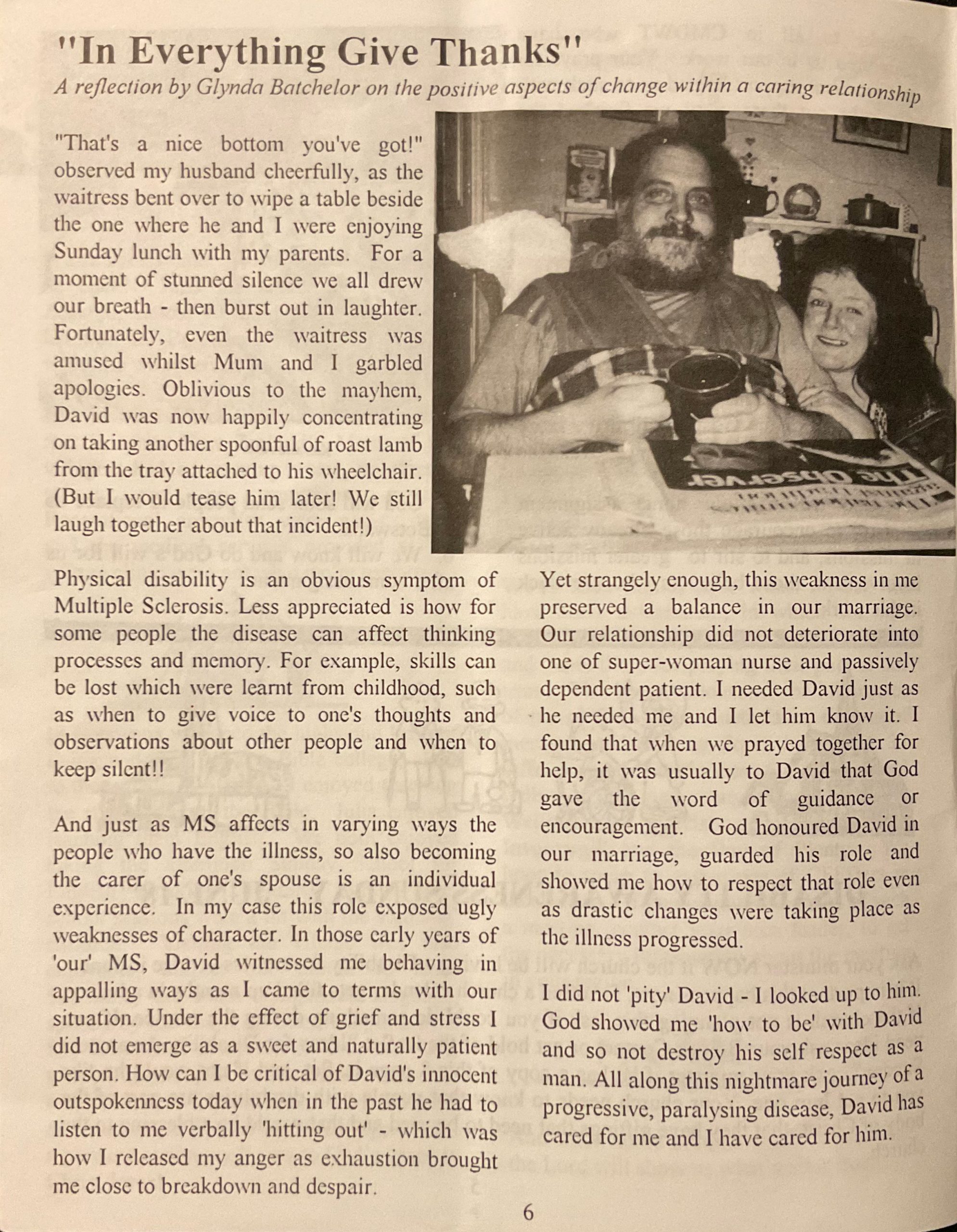
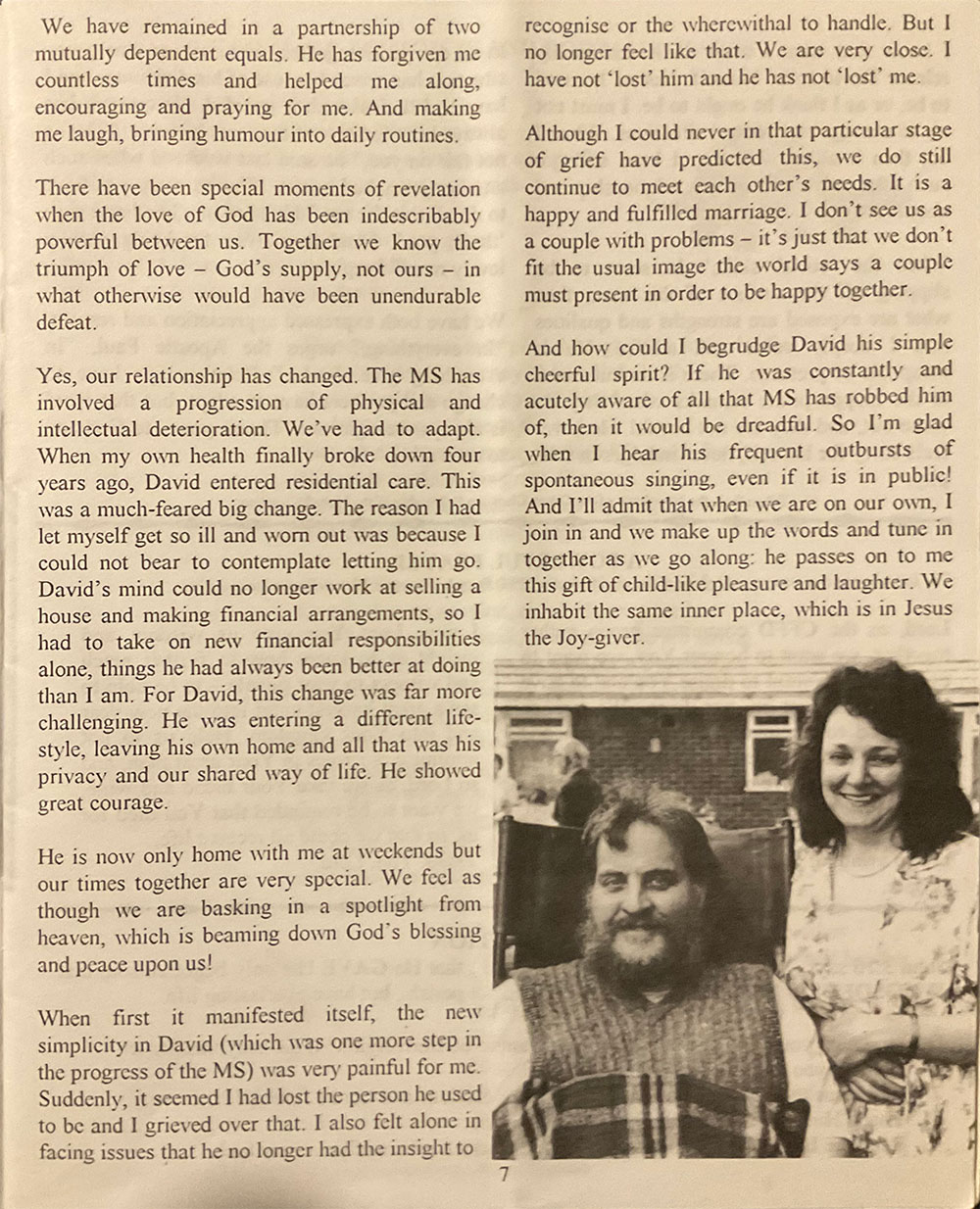
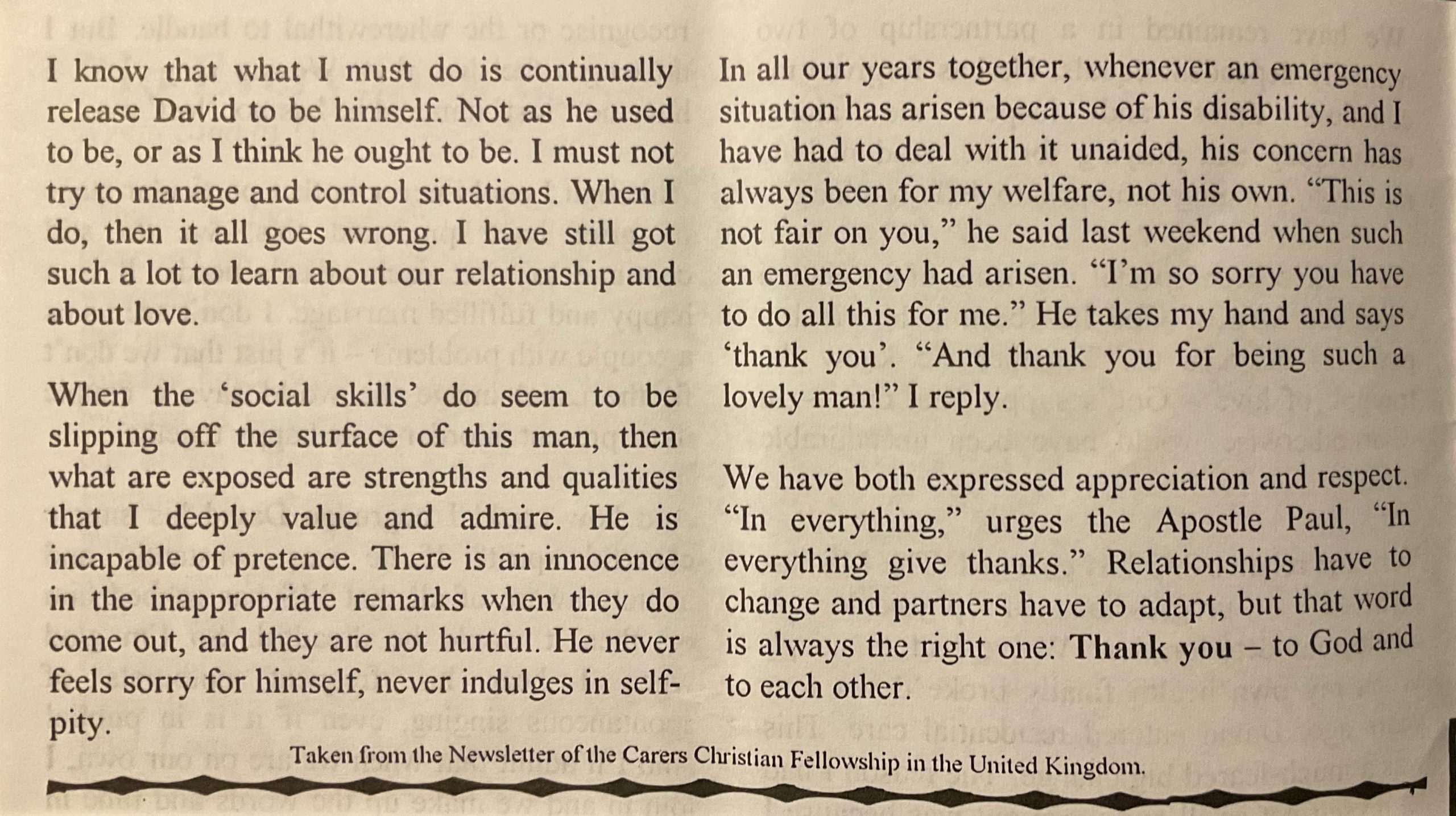
In Everything Give Thanks
Originally published by the UK Carers Christian Fellowship and here reproduced from the pages of a New Zealand newsletter of March 2000.
These three reflections with a poem appeared individually in editions of “Bible Reflections for older people” published by Bible Reading Fellowship in 2022 and in 2025. The aims of these reflections, BRF writes are “to bring hope, assurance and sustenance, reminding the reader of the presence and love of God” and that is why they are here on the Comfort For Carers website now.
The woman who wasn’t healed
The woman who wasn’t healed
I tunnelled towards him through the crowd.
Touched the edge
of a cloak as frayed as my life.
I gripped the dusty hem
between my thumb and forefinger.
That’s how close I came.
He looked down
and he understood and this
was the miracle I needed most.
I couldn’t hold onto him.
There was an issue of grief bleeding
belief dry. He knew
I couldn’t follow
as they all moved on
and he disappeared with his disciples.
But a knot of faith
came away in my hand.
I knelt by the road all night
unpicking the implications.
I’ve wound this one thin strand
around my finger like a ring:
My treasure, all that’s left of him.
I shall wear it to heaven.
He will remember me
When I come into his kingdom.
Poet Glynda Winterson introduces her poem ‘The woman who wasn’t healed’, an original, moving and through-provoking reflection on a well-known incident from the gospels.
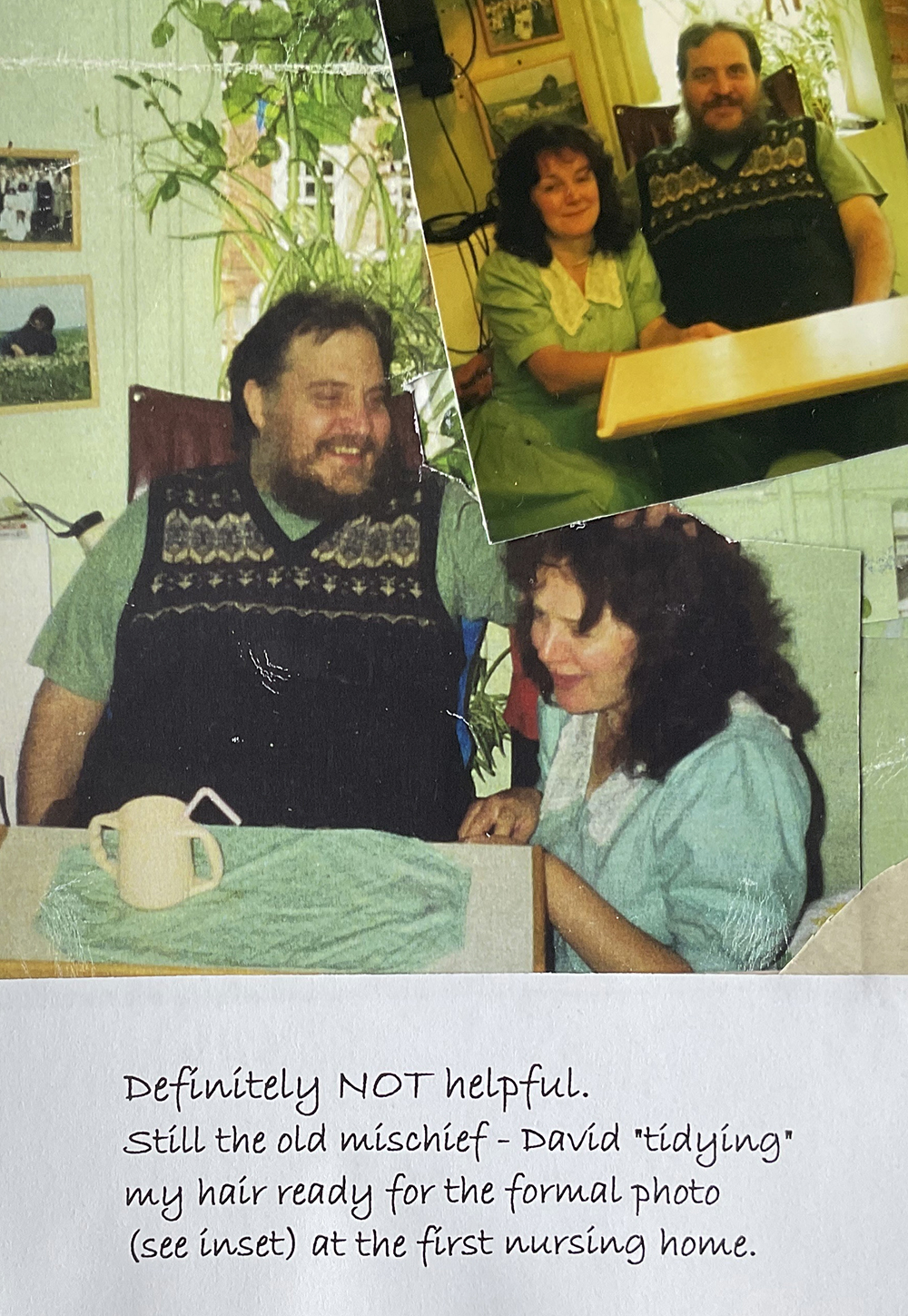
I accompanied my husband through 28 years of a paralysing progressive illness. Together we experienced a very close relationship with each other and with Christ throughout this time. My husband’s faith never wavered. Then suddenly, towards the end of those years, mine did. In fact, it seemed to have vanished. Did God even exist?
I did not connect this loss of faith with the ongoing grief and debilitating stress of the circumstances that I was experiencing. I was surprised when the woman in this poem made her appearance and seemed to attribute her problem with faith to having experienced a grief that had bled it dry.
When a poem arrives in my mind, it always seems to write itself. I ‘hear’ a phrase or a sentence apparently from nowhere and know I must note it down. Then amazingly more words and images follow it as if from nowhere, and I find that I have the first draft for a new piece of work. It seems to have a life of its own, independent of me.
So I cannot explain this poem. However, one of the things it is telling me is that we must not be discouraged if other believers seem to us to be striding on ahead with our Lord, so strong in faith compared to ourselves. What am I hearing here in this poem is the precious fact that Christ understands us even in our times of doubt and unbelief. It may seem that he has left us but through that ‘dark night of the soul’ he is holding onto us, even when we think that we have let go of him.
A King’s colours
Glynda Winterson introduces the second of her poems to feature in Bibles Reflections for Older People.
In traditional representations Mary, the mother of Jesus, is usually wearing the colour blue. This was due to a well-intentioned desire to honour her because in the ancient world blue and purple dyes were so rare and expensive that they were colours worn only by royalty.
But while these pictures may be beautiful, I admit to sometimes feeling impatient with those artists and movie directors who have offered their viewers an unrealistic or tidied-up version of the characters, circumstances and events in the Jesus story.
In this poem I have tried to dispel the other-worldly image so often presented to us. Mary lived in the real flesh-and-blood world as we all must. She was called to trust God even when, travelling to Bethlehem while heavily pregnant, did not seem to be arranging events to make her calling an easy one.
Sometimes we wonder why God has allowed particular difficulties to arise in our own lives. To be able to identify with someone who was as special as Mary and yet had to face life in all its gritty and sometimes grim reality can help strengthen our own faith and trust in God. Let us not allow the pretty but unrealistic pictures to hide the very real human being who inspired them.
A King’s colours
Amazed by our visions
of a dry swept-clean stable
of a shy mother kneeling
in cloudless sky coloured silk
(white hands idly clasped)
she might say
no one from Nazareth
could afford the blues
of lords and kings
and laugh remembering
wet straw on an innkeeper’s floor,
the baby’s sick on the undyed
sheep’s wool of her shawl
and her fingers still sore
red-raw from harvest,
from millstone, from cutting
the kindling for cooking,
from distaff and spindle and loom
or she might say nothing, no words
for the wonder and worry
interwoven over the years:
how from the hems and seams
of new tunics for a growing son
she would look up and watch him
at home with her in his earth colours.
Alone in the hills
Alone in the hills
From the full moon
enough reflected light
to make a shadow of himself.
He is here to pray.
He has become a man
of prayer and now
alone in the hills,
far from home, needing
in this moment
to be known and understood
there is comfort in his father’s
all-encompassing view
of the north and south
the east and west beyond
one tiny country’s inland sea
storm-blown below him now
where his disciples
struggling to believe
are rowing through the night
against the contradiction of the four winds.
Glynda Winterson is one of our favourite poets and she has recently published a new collection called Sweeping the Sea. One reviewer has commented: ‘These are delicate, tender poems that say a resounding “yes” to life, negotiating with honesty and grace the strange miracle of existence and the potential for faith in the face of certain pain and loss’.
Some of her poems are more overtly Christian than others, but they are all imbued with a spirit that is, in the words of another reviewer, ‘fierce, elemental….and ultimately redemptive’.
We are grateful to Glynda for permission to publish this poem from her new collection. She says of the poem:
‘It inspires worship and love and gives me great comfort and encouragement to know that Jesus the Son of God experienced what it is like to be human. When we pray we can be sure that Christ understands our feelings and emotions, including loneliness and the need to be fully known and understood, as in this poem.
‘Yet it is still a mystery where this poem came from! “Alone in the hills”, like all my poems, was begun without me knowing what it would be about or how it would end! A single phrase came to mind and I recognised it would grow to become a poem! And it did!’